Tattoo Ideas for Men (2026): Best Styles, Placements & Designs
Quick Answer: The best tattoo ideas for men in 2026 include blackwork sleeves, Japanese irezumi, geometric designs, realism portraits, fine line nature scenes, and traditional American motifs. Blackwork and geometric designs are particularly popular because they age well and work effectively in sleeve compositions. The right choice depends on your personal style, placement preference, and long-term plans for your ink.
Table Of Content
- Browse Men’s Tattoo Ideas by Category
- Why Tattoo Culture for Men Has Changed
- Best Tattoo Ideas for Men by Style
- Blackwork and Geometric Tattoos
- Japanese Irezumi
- Realism and Portrait Tattoos
- Traditional American and Neo-Traditional
- Fine Line and Minimalist Tattoos
- Tattoo Ideas for Men by Placement
- Forearm Tattoos for Men
- Upper Arm and Shoulder Tattoos
- Chest Tattoos for Men
- Back Tattoos for Men
- Tattoo Placement Comparison for Men
- Tattoo Ideas for Men by Theme
- Animal Tattoos
- Nature and Landscape Tattoos
- Cultural and Heritage Tattoos
- Skull and Dark Theme Tattoos
- Meaningful Tattoo Ideas for Men
- Small Tattoo Ideas for Men
- Cool Tattoo Ideas for Men
- Trending Tattoo Styles for Men in 2026
- How to Plan a Tattoo Sleeve
- How to Choose a Tattoo Artist
- Tattoo Aftercare for Men: The Medical Basics
- Final Thoughts on Tattoo Ideas for Men
- References
- What are the best tattoo ideas for men in 2026?
- Where should a man get his first tattoo?
- What tattoo style ages the best for men?
- How much does a high-quality tattoo for men cost?
- Do all tattoos hurt the same?
- How can I tell if a tattoo artist is truly professional?
- Can I cover up a tattoo I no longer like?
- What are meaningful tattoo ideas for men?
- Related Guides
Choosing a tattoo idea is one of the most personal decisions a man can make. Unlike clothing or a temporary accessory, a tattoo becomes a permanent part of your identity — something that ages with you, tells your story, and marks who you were the moment you decided to get it. The challenge today isn’t finding inspiration; with millions of designs online, there’s more visual noise than at any point in history. The real challenge is curation: knowing which styles suit your build, which designs age cleanly, and how one piece fits into the longer-term composition of your skin.
This guide covers the most effective tattoo ideas for men across every major style, placement area, and design theme — with practical guidance on choosing a piece that works for your anatomy, not just what looks good on a filtered Instagram feed.

Browse Men’s Tattoo Ideas by Category
Looking for something specific? These guides go deeper on each placement, style and theme.
- Arm and forearm: forearm tattoo design for men and arm tattoo ideas for men
- Sleeves: half sleeve tattoo ideas for men, full sleeve tattoo ideas for men and tattoo filler ideas for sleeves
- Chest: chest tattoo ideas for guys
- Small and simple: small tattoo ideas for men
- Meaningful and cool designs: meaningful tattoo ideas for men and cool tattoo ideas for men
- Filler and planning: tattoo filler ideas for men and tattoo stencils for men
Why Tattoo Culture for Men Has Changed
Tattooing has existed for over 5,000 years. The Smithsonian Institution documents the oldest known tattooed human, Ötzi the Iceman, discovered in the Alps in 1991, whose markings date to approximately 3,300 BCE. Across ancient cultures, tattoos marked social rank, spiritual protection, tribal identity, and life milestones — never purely decorative, always communicative.
That communicative function hasn’t disappeared — it’s evolved. Men today approach tattooing with more intentionality than previous generations: more attention to artist curation, long-term placement strategy, and how a design ages on the skin. The result is a modern tattoo culture that produces better fine art and demands smarter decisions from the people wearing it.
Best Tattoo Ideas for Men by Style
| Tattoo Style | Visual Vibe | Aging Factor | Best For |
|---|---|---|---|
| Blackwork | Bold & High Contrast | Excellent | Sleeves & Large Pieces |
| Japanese (Irezumi) | Dynamic & Flowing | Excellent | Full Body Suits & Sleeves |
| Fine Line | Precise & Minimal | Moderate | Small & Discreet Placements |
| Realism | Photorealistic | Variable | Portraits & Animal Murals |
| American Traditional | Iconic & Graphic | Superb | Timeless Classics |
| Cyber Sigilism | Futuristic & Coded | Good | Forearm & Full Sleeves |
| Geometric | Structured & Mathematical | Excellent | Sleeve Anchors & Chest |
Style is the most important decision you’ll make before settling on a subject. Two men can both request a lion tattoo and end up with completely different results depending on whether it’s executed in realism, traditional Japanese, bold blackwork, or geometric linework. Understanding the visual language of each style helps you pick one that complements your build and your long-term layout goals.
Blackwork and Geometric Tattoos
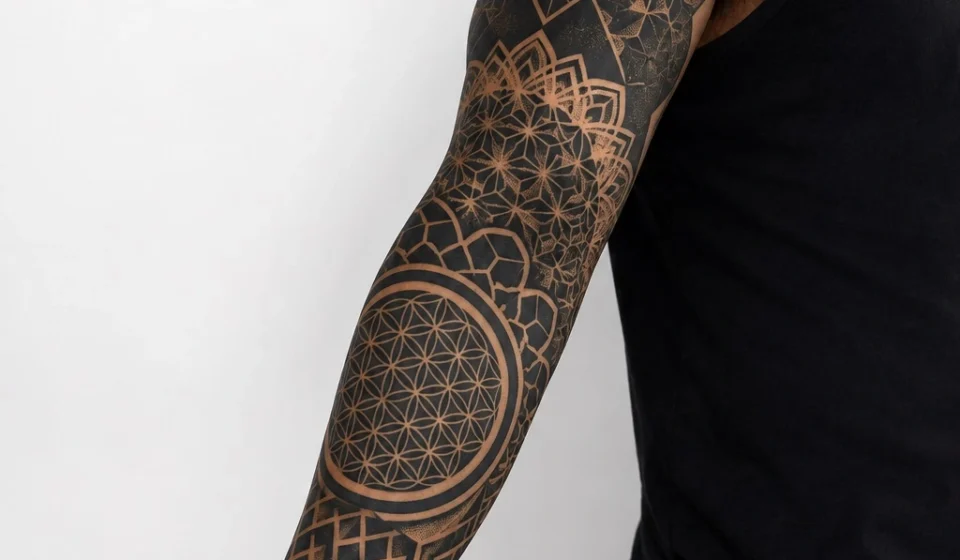
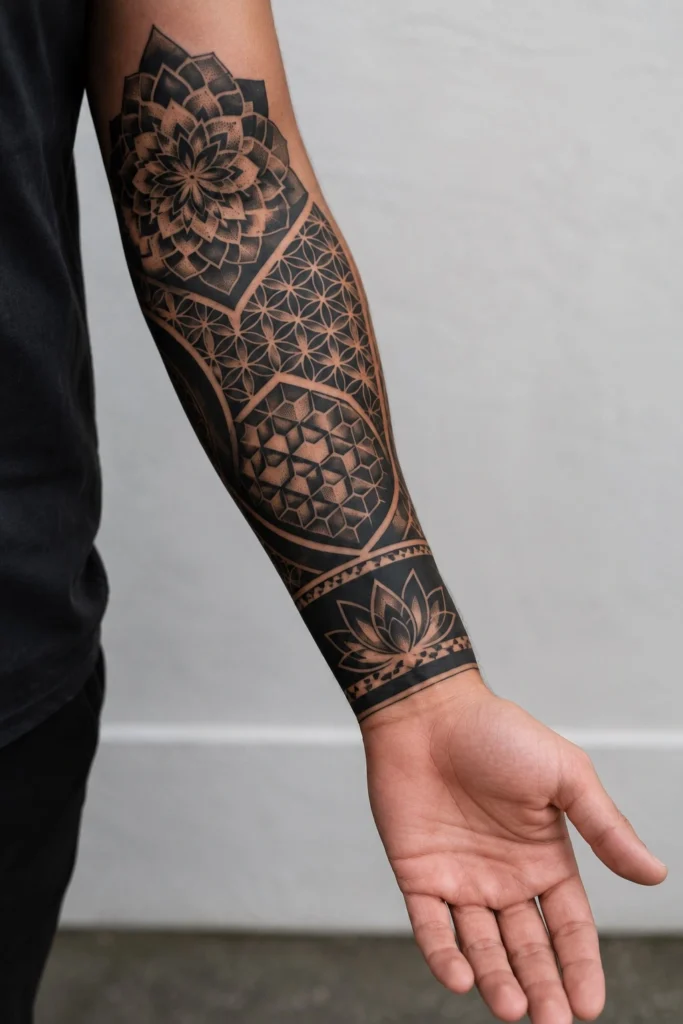
Blackwork remains dominant for practical reasons as much as aesthetic ones. Using only solid black ink — usually structured around bold shapes or high-contrast patterns — it ages better than colour or hyper-delicate work: the contrast stays readable across decades and the visual impact holds up from a distance.
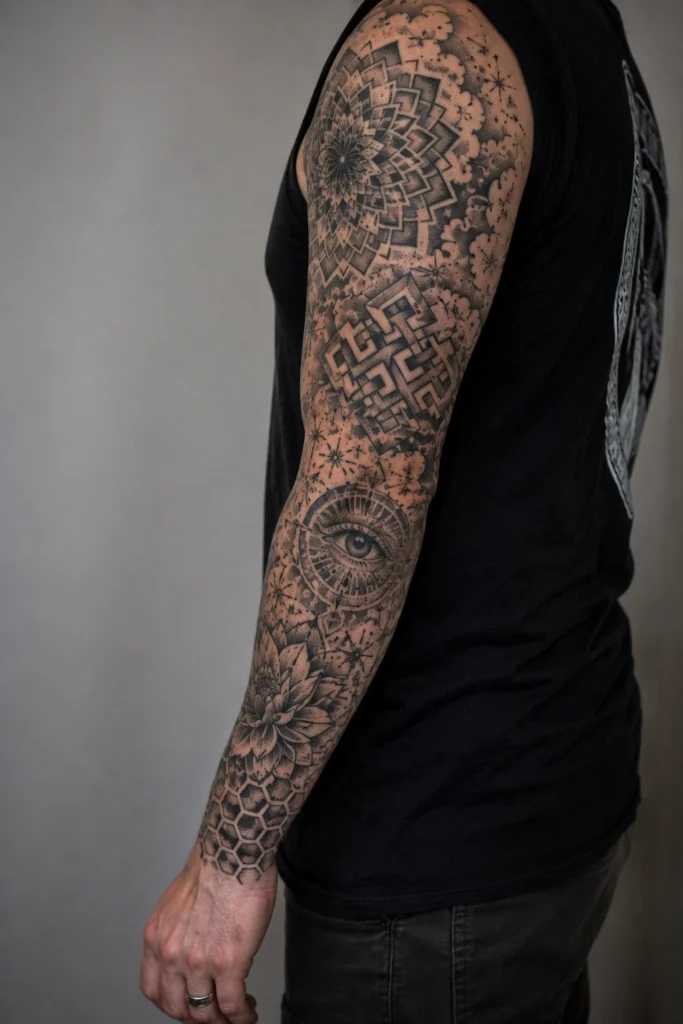
Geometric tattoos sit inside the broader blackwork category and suit the contours of the forearm, upper arm, and chest particularly well. Sacred geometry, mandala-inspired patterns, and abstract linework grids translate cleanly to these placements. For men building a sleeve over time, geometric patterns act as a framework that later pieces can connect to using dotwork and negative space, without the composition turning cluttered.
Japanese Irezumi
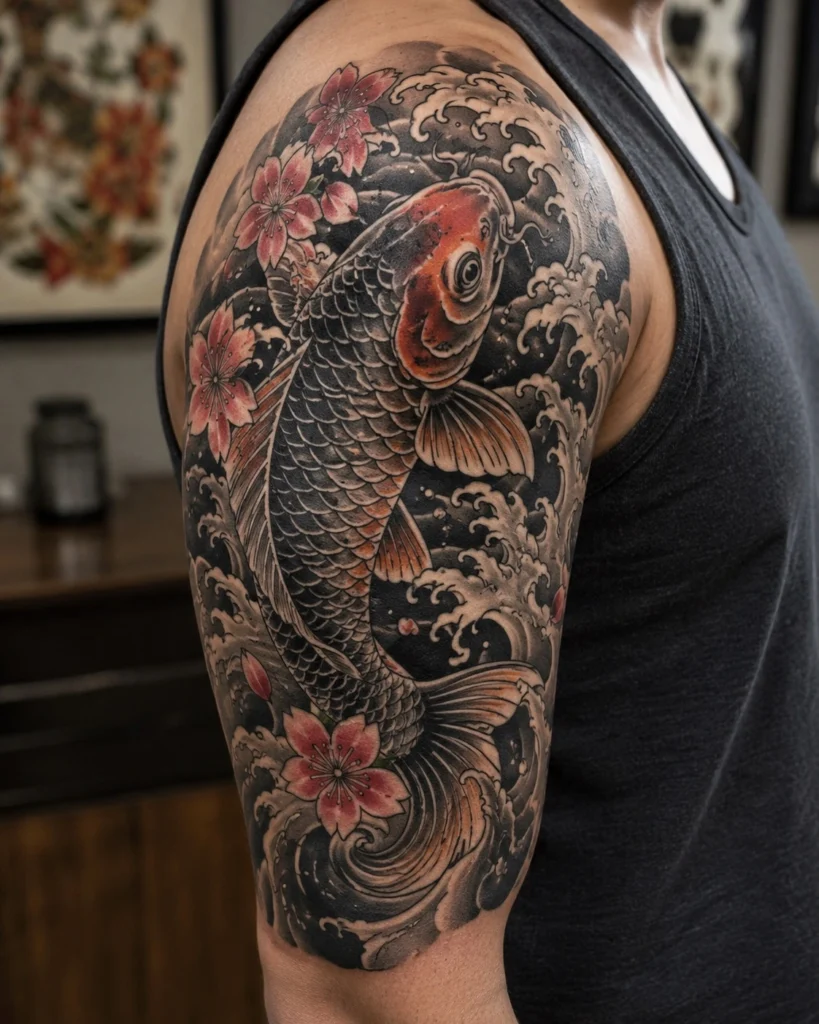
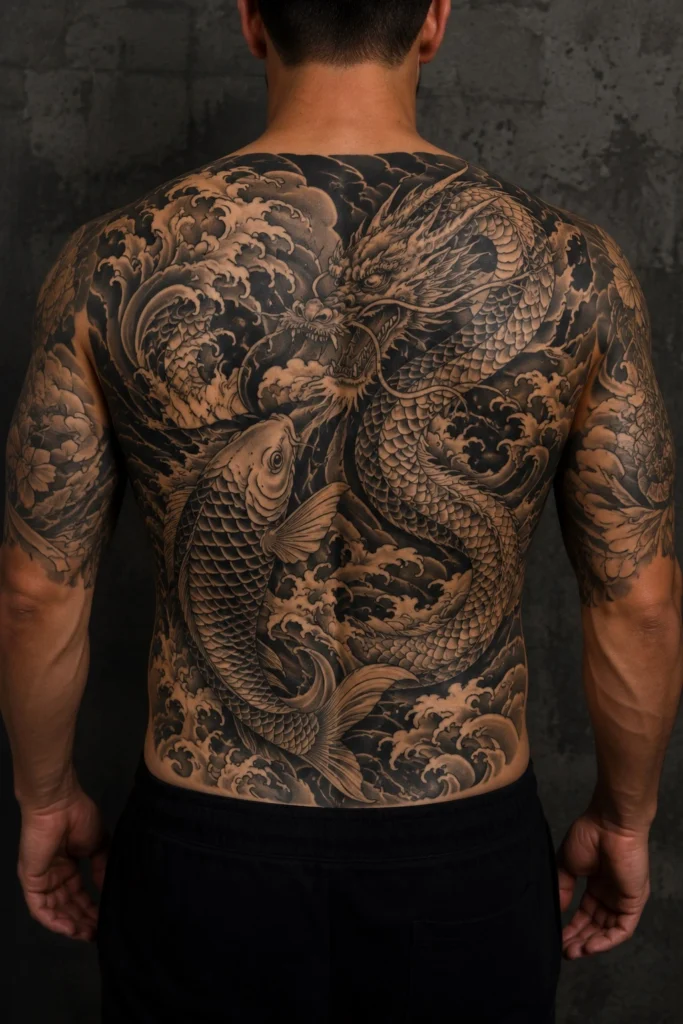
Traditional Japanese tattooing, or irezumi, is one of the most respected and technically demanding traditions in body art. It’s anchored by a strict, symbolic visual vocabulary: koi fish for perseverance, dragons for wisdom and strength, tigers for courage, cherry blossoms for the transience of life, and heavy wave backdrops for the power of nature. These motifs have carried the same cultural weight for centuries.
What makes irezumi effective is how it flows with human anatomy. Designed with the understanding that the body is a moving canvas, it wraps around limbs and the torso in a way that follows muscle definition rather than fighting it. For anyone planning a cohesive half or full sleeve, this is one of the few styles built for that from the start.
Realism and Portrait Tattoos
Realism — reproducing photographic detail with subtle ink gradients — is the hardest style to execute well. In the hands of a specialist with a proven track record, a realism portrait or animal study is striking. In the hands of someone without one, it can age poorly and be difficult or expensive to correct.
The most requested realism subjects for men are lions, wolves, bears, and portraits of family or historical figures. Animal realism translates well to the rounded upper arm and shoulder, where muscle mass gives the artwork a three-dimensional quality. For portrait work specifically, ask to see healed portfolio examples from several months or years post-session — not just fresh, red photographs.
Traditional American and Neo-Traditional
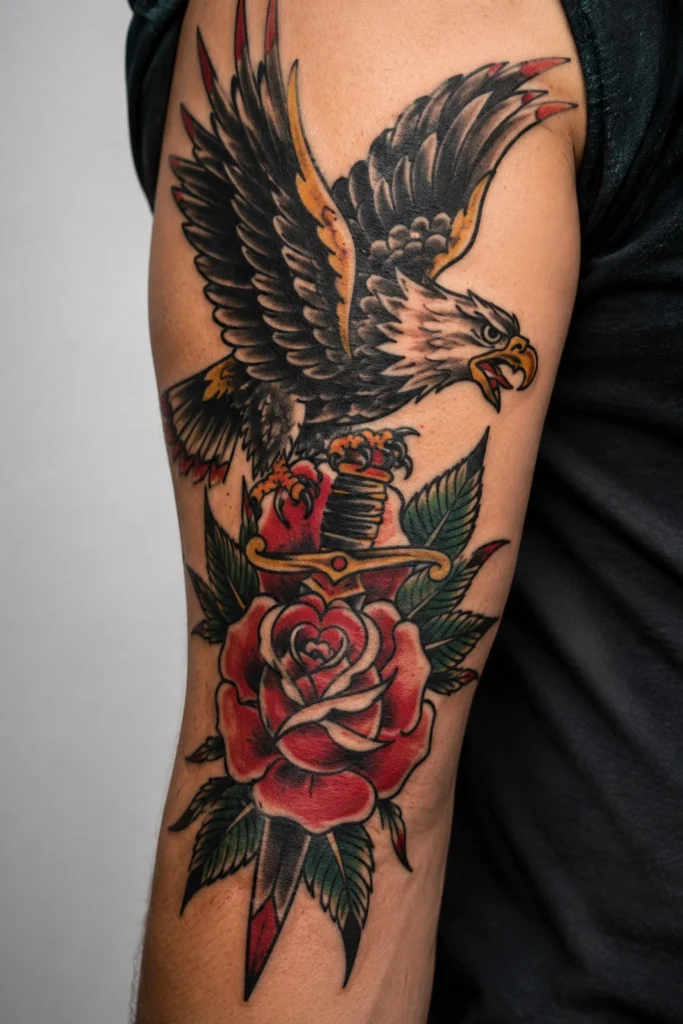
Defined by heavy black outlines, a concentrated colour palette, and maritime imagery like eagles, anchors, daggers, and roses, Traditional American tattooing is the bedrock of the modern industry. The Smithsonian American Art Museum notes how Samuel O’Reilly’s 1891 electric tattoo machine, adapted from Thomas Edison’s electric pen, turned tattooing from a slow hand process into a widespread, accessible trade across port cities.
Traditional tattoos age well because of a simple structural rule: bold lines hold. Thick outlines keep pigment separated, flat colour stays readable, and simple imagery remains recognisable even as fine detail softens over the years. Neo-traditional builds on that foundation with custom colour gradients and broader subject matter, while keeping the same high-contrast bones.
Fine Line and Minimalist Tattoos
Fine line and minimalist tattoos have moved from niche subculture to mainstream default. Using single needles, delicate linework, and calculated negative space, these pieces read as understated and precise — a common choice for professionals who want something visible but easy to keep low-key, on zones like the outer forearm or upper bicep.
The practical tradeoff is ink migration over time. Lines placed too thin or too close together will spread and blur as skin cells regenerate. Good fine-line work compensates with scale — usually a minimum of four to six inches — and relies on composition rather than dense micro-detail to make its point.
Tattoo Ideas for Men by Placement
Placement isn’t just about where a design looks best today — it determines how the artwork moves with muscle contraction, how it holds up against sun exposure, and how well it translates across professional and social settings.
Forearm Tattoos for Men
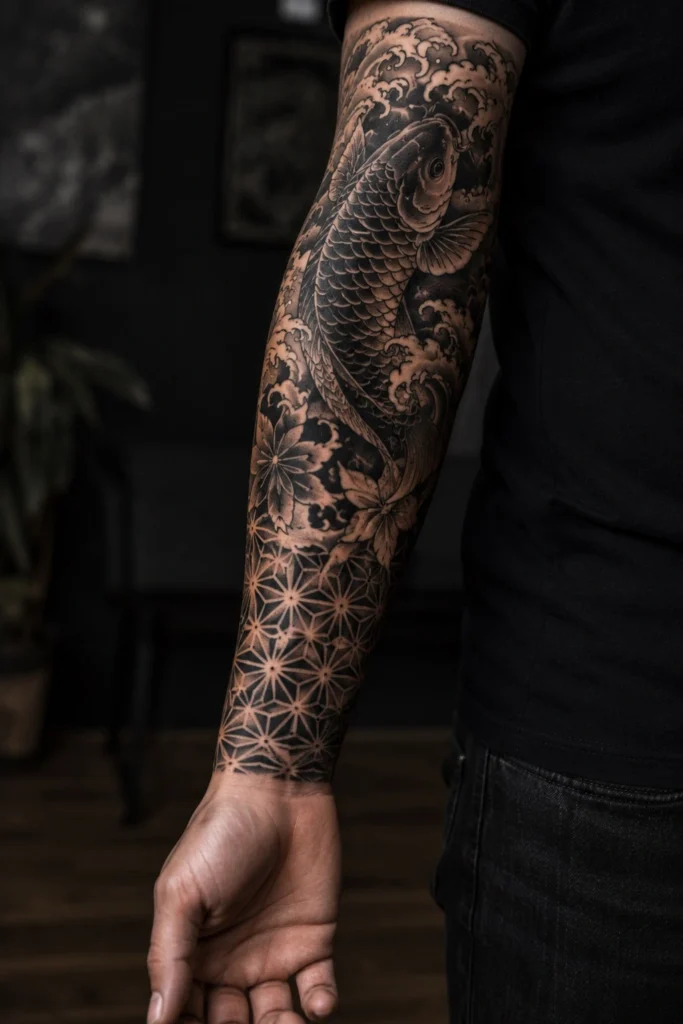
Of forearm tattoos for men every placement in this guide, the forearm is the one most men start with. It’s a flat surface that distorts little during movement, heals consistently, and can be shown or covered with a button-down shirt depending on the setting. For pain zones by section, sizing guidance, inner-vs-outer forearm tradeoffs, and 30+ specific design directions, see our complete forearm placement and sizing guide.
Upper Arm and Shoulder Tattoos
Backed by dense muscle and thicker skin, the upper arm and shoulder are among the lower-pain placements on the body, which makes them practical for long, complex sessions. They’re also easy to hide under a standard t-shirt for work, while offering a large, three-dimensional canvas for wrapped realism, tribal patterns, or illustrative pieces over the deltoid. For a full breakdown of arm placements, styles and sleeve development, see our arm tattoo ideas for men guide.
Chest Tattoos for Men
The chest’s flat, broad surface supports ambitious, symmetrical compositions — a central focal piece flanked by supporting geometric or organic elements, in a way an arm can’t accommodate. The sternum carries more sensitivity, but the main pectoral plates are manageable for most people. For everything from sternum designs to full chest panels, see our dedicated chest tattoo ideas for men guide.
Back Tattoos for Men
The back offers the single largest continuous surface on the body, reserved for large-scale work. Full back pieces running from the nape of the neck down require serious time commitment. Traditional Japanese back pieces and heavy blackwork murals here are usually completed over several long-form sessions spread across years, not months.
Tattoo Placement Comparison for Men
| Placement | Pain Level | Visibility Control | Longevity Factor | Best Visual Styles |
|---|---|---|---|---|
| Forearm | Low to Moderate | High (Easy to cover/show) | Excellent | Blackwork, Fine Line, Geometric |
| Upper Arm | Low | Very High (Shirt hides it) | Excellent | Realism, Japanese, Traditional |
| Chest | Moderate to High | Excellent (Hidden by default) | Great | Symmetrical Geometric, Neo-Trad |
| Back | High (Spine & Ribs) | Maximum Discretion | Superb | Large-Scale Japanese, Blackwork |
| Shoulder | Low | Medium-High | Excellent | Florals, Mandalas, Caps |
| Wrist | Moderate | High | Good (touch-ups needed) | Script, Minimal Symbols |
Strategic breakdown comparing pain, visibility, and longevity across primary male tattoo placements.
Tattoo Ideas for Men by Theme
Animal Tattoos
Animal motifs stay popular because they project recognisable character traits: strength (lions, bears), wisdom (owls), loyalty (wolf packs), transformation (monarchs, koi), and freedom (eagles). The style you choose shifts the tone entirely — a photorealistic lion reads serious and classic, while a geometric variant reads modern and architectural.
Nature and Landscape Tattoos
Nature-inspired concepts — mountain skylines, pine forests, ocean currents, botanical diagrams — remain popular with men looking for impact without aggression. Fine-line mountain rings around a bicep or botanical leaves used as sleeve filler are strong current choices: quiet, grounded, and not trying to shout for attention.
Cultural and Heritage Tattoos
Art rooted in personal genealogy — Polynesian patterns, Celtic knotwork, Norse runes, Maori ta moko — carries real autobiographical weight. Smithsonian Magazine notes that across ancient history, tattoos performed communicative roles: indicating status, protective belief, and community alliance. Modern heritage collectors carry that legacy forward.
Skull and Dark Theme Tattoos
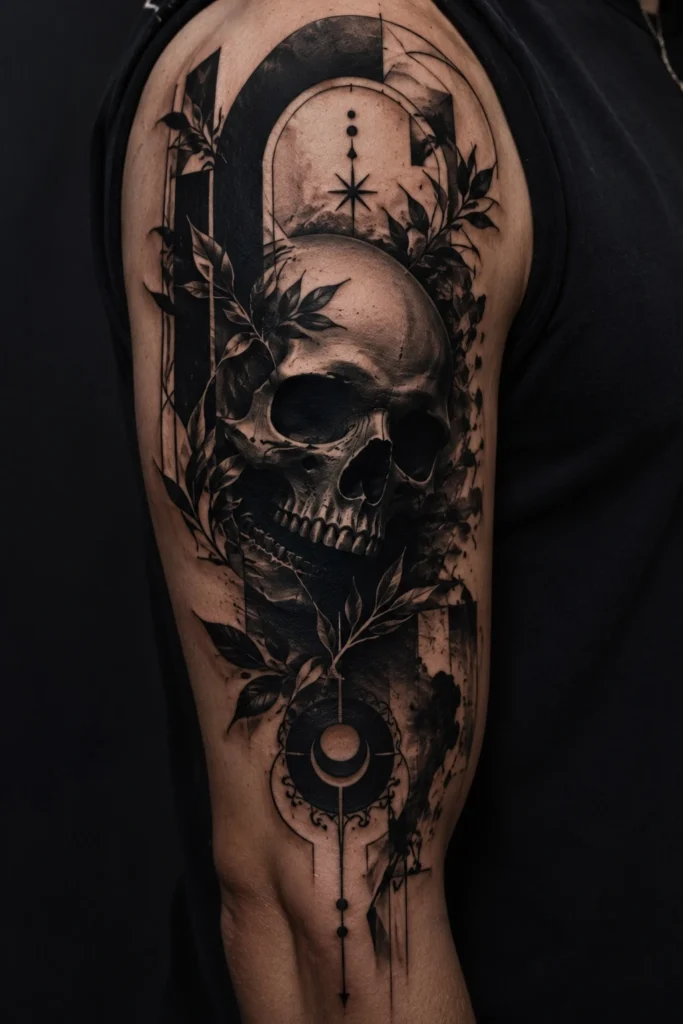
Skulls, gothic architecture, memento mori imagery, and dark realism remain popular mainstays. Approached with intent rather than shock value, dark motifs work as statements about mortality, survival, and resilience. They tend to land best inside heavy blackwork or moody neo-traditional frameworks.
Meaningful Tattoo Ideas for Men
The most enduringly satisfying tattoos for men are almost always the ones with genuine personal meaning — designs connected to real biographical events, significant people, earned values, or personal transformation rather than purely aesthetic appeal. A wolf that represents the loyalty of a specific group of people in your life carries fundamentally more long-term resonance than the same wolf chosen because it looks impressive. For the full range of symbolic and thematic options, our dedicated meaningful tattoo ideas for men guide covers every major symbol category in depth – from animal motifs and heritage designs to memorial pieces and cultural symbols.
Small Tattoo Ideas for Men
Not every impactful tattoo needs to be a sleeve or a chest panel. Some of the most considered pieces men wear are small – a single symbol on the inner wrist, a minimal geometric element on the forearm, a meaningful word in clean typography. Small tattoos demand more design discipline than large pieces because there is nowhere to hide a poor decision at a small scale. For everything from micro-realism animal studies to minimal meaningful symbols and how to place small pieces as future sleeve anchors, see our small tattoo ideas for men guide.
Cool Tattoo Ideas for Men
In 2026, the coolest men’s tattoos share one quality: they look like they were designed for the specific body they are on, rather than selected from a catalogue and placed without compositional awareness. Cyber sigilism patterns that follow the forearm’s muscle lines, geometric blackwork sleeves built around a coherent visual concept, Japanese irezumi compositions that animate with muscle movement, and hyper-realistic animal portraits that use the bicep’s curvature for three-dimensional depth – all of these demonstrate the kind of intentional design thinking that separates genuinely impressive ink from random accumulation. For the full breakdown of what is dominating men’s tattooing visually in 2026, see our cool tattoo ideas for men guide.
Trending Tattoo Styles for Men in 2026
Cyber Sigilism: Circuit-like mechanical lines merged with occult or tribal shapes. Popular among tech and design creatives — it reads simultaneously ancient and futuristic across the skin.
Micro-Realism: Hyper-detailed, photographic rendering scaled down to miniature sizes, letting collectors fit complex imagery into small, discreet spaces. Closely related “sticker-style” layouts treat each piece as a standalone, modular addition rather than forcing an immediate unified composition.
Bio-Organic Blackwork: A newer offshoot that blends organic, flowing forms – roots, veins, coral-like branching — with the solid black shading of traditional blackwork. Where geometric blackwork uses straight lines and symmetry, bio-organic pieces follow the body’s natural curves instead, making them increasingly popular as gap fillers between larger sleeve pieces.
How to Plan a Tattoo Sleeve
If your goal is a full sleeve rather than separate, disjointed pieces, the planning approach needs to be different from the start. The most important compositional decisions happen before a needle ever touches your skin.
Pick one style family and stick to it. A sleeve built entirely from structured Japanese irezumi is cohesive by default. A patchwork arm mixing hyper-realism, old-school traditional, and neon geometric elements can look unfocused unless an experienced artist ties it together deliberately. Deciding on a visual theme early avoids the most common mistake: individually good tattoos that look chaotic as a set.
Don’t ignore gap fillers. As you add main subjects over the years, the remaining open space needs intentional connective work — wind bars, dotwork shading, organic smoke, geometric fragments. Our tattoo filler ideas for men guide breaks down how to tie those elements into one cohesive sleeve. For patchwork-specific sleeve compositions, our patchwork sleeve guide covers the full range of connecting approaches.
How to Choose a Tattoo Artist
Your choice of artist affects final quality more than the design concept itself. A skilled artist can turn a simple idea into something excellent; an unproven one can ruin a great concept.
Base your assessment on healed work, not fresh sessions. Freshly finished tattoos look sharp and smooth because of skin inflammation — that’s not what the piece will look like in a year. A portfolio with photos shot six months to a year post-healing shows you how the artist’s ink retention and needle depth actually hold up. No healed gallery is a warning sign.
Book a sit-down consultation first. A good artist will assess your skin undertone, look at your muscle lines, suggest sizing adjustments, and tell you honestly if an idea won’t age well – rather than rushing you into the chair. For heavy illustrative work, three-to-four hour sessions tend to keep focus and skin trauma manageable.
Tattoo Aftercare for Men: The Medical Basics
The first few weeks after a session determine how clean your linework stays for decades. Treat a fresh tattoo like an open wound: clean it gently with unscented, antibacterial liquid soap, pat dry with a clean paper towel, and apply a thin layer of healing ointment twice a day. Avoid picking at scabs, stay out of direct sun, and skip pools, hot tubs, and baths for at least three weeks.
According to the American Academy of Dermatology, the top protective layer of skin typically closes within two to three weeks, but the deeper dermal layers can take up to three months to fully restructure. That’s why the final clarity and texture of a tattoo is only really judged at the three-month mark, not right after the session. Daily SPF 50 on healed tattoos in sun-exposed areas significantly slows fading over time.
This section covers general aftercare practice, not medical advice. If you notice unusual swelling, spreading redness, fever, or discharge, contact a doctor – these can be signs of infection.
Final Thoughts on Tattoo Ideas for Men
The best tattoo designs aren’t the ones chasing flash trends – they’re the ones placed intelligently on the body’s natural architecture and aligned with your actual identity. Whether you go with heavy blackwork, Japanese irezumi, fine-line minimalism, or bold traditional outlines, execution is what matters. Take your time, vet your artist rigorously, map out your long-term skin landscape early, and invest in something you’ll want to wear for life.
References
- Smithsonian Institution: Ancient Ink — Iceman Ötzi Has World’s Oldest Tattoos
- Smithsonian Institution: A Revolution in Tattooing
- Smithsonian Magazine: The Worldwide History of Tattoos
- American Academy of Dermatology: Tattoo Aftercare Guide
What are the best tattoo ideas for men in 2026?
The best tattoo ideas for men in 2026 include blackwork sleeves, Japanese irezumi, geometric designs, realism portraits, fine line nature scenes, and traditional American motifs. Blackwork and geometric designs are particularly popular because they age well and work effectively in sleeve compositions. The right choice depends on your personal style, placement preference, and long-term plans for your ink.
Where should a man get his first tattoo?
The forearm and upper arm are the most popular first tattoo placements for men. Both areas offer good surface area, moderate pain levels, and the versatility to show or conceal the tattoo depending on context. The outer forearm is the most visible and best suited for bold designs, while the inner forearm works well for meaningful script or personal symbols.
What tattoo style ages the best for men?
Blackwork and traditional American tattoos age the best of any styles. Bold outlines hold their shape over time, solid black ink retains its contrast, and the strong visual structure stays readable as skin changes. Fine line tattoos require more maintenance and touch-ups to stay looking sharp, particularly in areas with significant sun exposure or skin movement.
How much does a high-quality tattoo for men cost?
Tattoo pricing varies by artist experience, location, and design complexity. Figures reported across the industry commonly range from roughly $100 to $300 per hour for experienced artists, though this varies significantly by studio and region. Always confirm exact pricing directly with your chosen artist during consultation.
Do all tattoos hurt the same?
No, pain levels vary drastically based on location. Areas with less fat and muscle and more bone — such as the ribs, sternum, feet, and inner elbows — are significantly more painful to tattoo. Areas with thicker skin and muscle mass, like the outer forearm, upper arm, and outer thigh, are generally considered the most manageable placements for first-time clients.
How can I tell if a tattoo artist is truly professional?
Look for an artist who specialises in the style you want. A professional will always provide a portfolio of fully healed tattoos, not just fresh, red, and swollen photos. A good artist will also offer a consultation to discuss your skin type, placement, and long-term aging concerns, rather than rushing you into a seat.
Can I cover up a tattoo I no longer like?
Yes, cover-up tattoos are a common solution for outdated or poorly executed ink. A successful cover-up usually requires a design that is larger, darker, or more complex than the original piece. Consult with an artist who specialises in cover-ups, as they can assess if your current design needs a few sessions of laser lightening before a new piece can be layered over it.
What are meaningful tattoo ideas for men?
Meaningful tattoo ideas for men include wolf and lion symbols representing loyalty and courage, compass and anchor motifs tied to direction and stability, phoenix designs marking resilience, cultural heritage patterns carrying biographical identity, memorial script honouring significant people, and nature motifs representing personal values. The most powerful meaningful tattoos are the ones whose significance is genuinely biographical.
Related Guides
- Forearm Tattoo Design for Men: Styles and Placement Guide
- Arm Tattoo Ideas for Men: Sleeve, Forearm and Upper Arm
- Chest Tattoo Ideas for Guys: Bold Designs and Placement Guide
- Meaningful Tattoo Ideas for Men: Symbols and Deep Meaning
- Cool Tattoo Ideas for Men (2026): Styles, Sleeves and Designs
- Small Tattoo Ideas for Men: Minimal and Meaningful
- Tattoo Filler Ideas for Men: Sleeve and Gap Designs
- Tattoo Filler Ideas for Patchwork Sleeves